
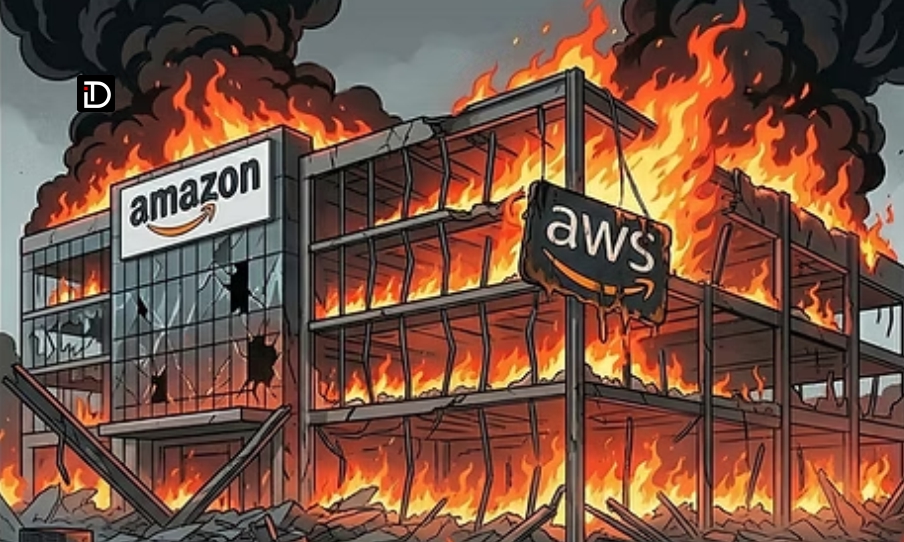
A sudden change swept through today’s battles after online actions met real-world force near the Persian Gulf. News from London-based reporters plus statements by regional officials reveal coordinated attacks hit major hubs that keep international data flowing. What stands out came late Tuesday – Iranian forces moved against Amazon buildings on an island nation, a sharp turn showing governments now aim at company-run systems amid rising tensions.
Something like this did not happen by chance. It ties into broader tensions across the region, pulling U.S. tech firms deeper into conflict zones. With each move the IRGC makes, more companies find themselves marked – no longer safe behind digital walls. What once stayed online now spills into steel and concrete. Servers burn. Machines break. This kind of attack does not steal data – it crushes the machines holding it.
The Physical Weakness of the World’s Cloud Infrastructure
Cloud computing once seemed like magic floating somewhere far away. Truth is, it runs inside giant warehouses sucking huge amounts of power – hardly invisible at all. Iran attacking Amazon’s systems shows how risky it becomes when so much data piles up in unstable parts of the world. Even with strong digital shields, those centers rarely have serious weapons ready to stop waves of drones or missiles overhead. Surprisingly thin protection for something we rely on so heavily.
One moment everything works. Then black screens in Bahrain, silent phones in Dubai. Shops cannot process payments. Banks freeze. Government portals go dark. Because a blast hits one building – Amazon’s hub – and whole systems start failing. It does not take an army. Just precise damage in the right place. Modern economies run on invisible threads. Those threads snap like wires under fire. Factories once burned. Now servers do. Progress did not erase risk – it moved it underground.
Retaliation Against the Silicon Valley Giants
The motivation behind these maneuvers appears to be a direct response to the perceived role of Western technology in military operations. The IRGC has explicitly threatened to target U.S.-based firms, claiming that their platforms and AI tools provide a tactical advantage to adversaries. The moment iran strikes amazon, it sends a chilling message to other tech behemoths like Google and Microsoft that their presence in the Middle East is no longer considered neutral territory.
By labeling these companies as “enemy technology infrastructure,” Tehran is signaling that it views the digital economy as an extension of U.S. soft and hard power. This strategy aims to rattle the global economy and pressure Western allies to reconsider their defense partnerships. Every time iran strikes amazon, it increases the insurance premiums and security costs for any multinational corporation operating in the Gulf, effectively creating a “tech tax” on regional stability.
A New Legal Frontier in Modern Conflict
The legal community is now grappling with the implications of these unprecedented events. Under the Law of Armed Conflict, civilian objects are generally protected; however, if a data center is being used to support military intelligence or decision-making, it may lose its protected status. The ambiguity of this situation is exactly what makes the news that iran strikes amazon so complex. Determining whether a server farm is a civilian marketplace or a military target is a challenge for which current international law is largely unprepared.
Furthermore, these incidents are forcing a massive rethink of “Availability Zones” and data redundancy. If iran strikes amazon locations repeatedly, the corporate world must shift from a model of efficiency to one of extreme resilience. Companies are now being advised to migrate workloads to more stable regions, which could lead to a digital exodus from the Middle East, potentially stifling the region’s long-term technological growth.
The Future of Sovereign Data and Security
As the dust settles from the latest explosion in Bahrain, the global community is left to wonder what comes next. The precedent set when iran strikes amazon cannot be easily undone. It has proven that data centers are the new high-ground in 21st-century warfare. Governments may soon require that critical national data be stored in “hardened” facilities, or perhaps even in underground bunkers, to protect them from similar kinetic threats.
The economic fallout is also just beginning to be calculated. When iran strikes amazon, the ripples are felt by every startup and enterprise that relies on that specific cloud region. This volatility may lead to a more fragmented internet, where nations prioritize “sovereign clouds” located deep within their own borders and protected by their own missile defense systems.
Ultimately, the news that iran strikes amazon is a wake-up call for the entire tech industry. The era of assuming that digital assets are immune to the physical realities of war is over. As technology continues to integrate into every facet of our lives, the physical buildings that house our data will remain primary targets for those looking to disrupt the status quo. The security of the cloud is no longer just a matter of firewalls and encryption; it is now a matter of physical defense and geopolitical strategy. Each time iran strikes amazon, the world moves one step closer to a future where the digital and the tactical are one and the same.