
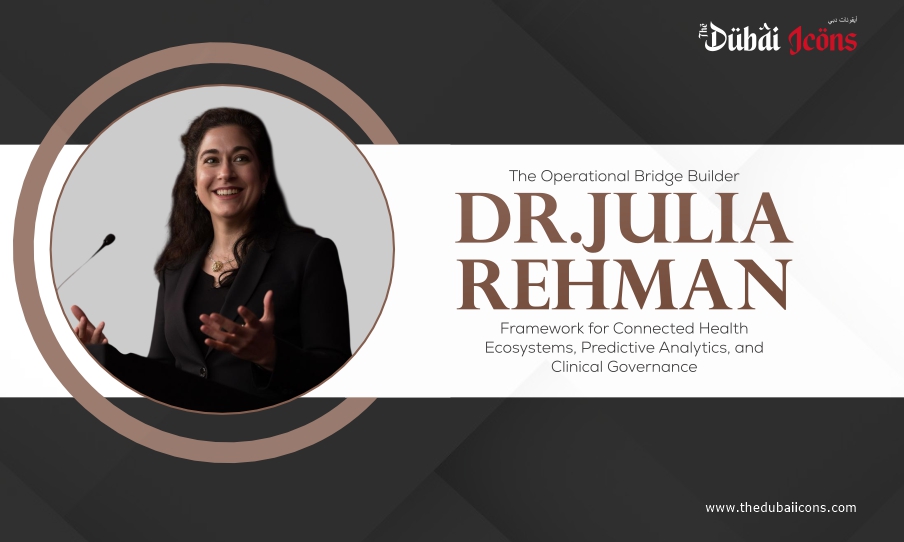
Times are transformed constantly, always by the most influential leaders who are driving positive change in every sector. In the sector of technology, especially in the Arab’s healthtech niche, Dr. Julia Rehman is recognized today as a force of that transition. In this region, medical facilities face rising patient volumes and evolving diagnostic requirements. In fact, across the Arab world, the modern healthcare infrastructure undergoes intense structural modernization. Redesigning modern care delivery with high-impact clinical systems, Dr. Julia Rehman drives this shift by introducing advanced operational frameworks that optimize care delivery and patient outcomes.
She manages the complex intersection of clinical data workflows and everyday hospital operations. She has over eighteen years of proficiency in holding leadership roles in healthcare technology and digital transformation. She is the Founder and COO of Kota Kompany LLC. And installs specialized digital platforms. These platforms remove systemic administrative friction. This, in effect, allows doctors and nurses to dedicate their time to frontline medical care.
This continuous operational refinement establishes Dr. Julia Rehman’s position among the prominent technology leaders to watch across the region. Hospital networks look to her expertise to rebuild legacy software pipelines into predictive, responsive healthcare ecosystems. By introducing real-time resource tracking and automated scheduling protocols, she and her company protect high-value diagnostic assets from underutilization. The resulting technical setup ensures that critical patient processing data moves instantly between laboratories and care wards, shortening patient wait times and securing strict data confidentiality throughout the medical network.
The Scale of Transformation: Bridging Clinical Care, Operational Performance, and Public Health
Dr. Julia Rehman’s journey into healthcare transformation was never solely about technology. It was about solving operational and human problems at scale. Early in her career, she worked across provider, payer, pharmaceutical, and healthcare delivery environments and saw firsthand how fragmented systems, disconnected data, and operational inefficiencies directly affected patient care, clinician experience, and organizational sustainability. What inspired her most was recognizing that healthcare technology is not simply an IT function. It is a leadership function. When implemented correctly, it becomes a bridge between clinical care, operational performance, public health, and long-term organizational strategy. Working across the United States, Saudi Arabia, the UAE, and India also gave her a broader perspective on healthcare inequities, infrastructure maturity, workforce challenges, and population health priorities. She became deeply interested in how healthcare systems can modernize responsibly while still remaining patient-centered and operationally grounded. That combination of healthcare administration, analytics, operations, governance, and public health ultimately shaped her leadership philosophy. She has always believed that transformation is not about implementing technology for the sake of innovation. It is about building healthcare systems that are more connected, sustainable, equitable, and resilient for the communities they serve.
The Kota Kompany Model: Delivering Operationally Aligned Transformation and Ecosystem Advisory
Kota Kompany was built around the idea that healthcare organizations need more than isolated technology implementations. They need operationally aligned transformation strategies that connect data, leadership, governance, workflow redesign, and long-term organizational outcomes. Dr. Julia Rehman’s focus is on helping organizations move from reactive operations toward intelligent, data-informed decision-making environments. That includes enterprise analytics, operational readiness, governance modernization, healthcare strategy, digital transformation, and executive advisory support across healthcare ecosystems. What differentiates her approach is that she does not view transformation through a purely technical lens. She approaches it through healthcare operations, public health, organizational performance, and executive leadership. Technology should strengthen healthcare delivery, not complicate it. She is particularly passionate about supporting healthcare organizations serving rural, underserved, and rapidly growing populations. As healthcare demands continue to increase globally, systems must become more scalable, interoperable, and operationally sustainable. That requires leadership models that integrate strategy, analytics, governance, and frontline operational realities together.
The Intelligent Predictive Future: Mastering Data Governance, Workforce Alignment, and Operational Integration
Dr. Julia Rehman has worked extensively at the intersection of healthcare operations, AI, enterprise analytics, and data governance. She believes healthcare leadership will increasingly shift from retrospective management toward predictive and operationally intelligent decision-making. The future is not simply about AI replacing human decision-making. It is about helping leaders manage complexity more effectively. Healthcare executives are now expected to oversee clinical quality, workforce sustainability, financial performance, operational efficiency, regulatory compliance, cybersecurity, and patient experience simultaneously. Intelligent technologies can help leaders identify patterns earlier, improve operational visibility, optimize resource allocation, and support more proactive interventions.
However, Dr. Julia Rehman also believes healthcare organizations are moving beyond the phase where AI itself is the differentiator. Governance, interoperability, data quality, adoption strategy, and operational integration will become the true differentiators. Organizations that succeed will be the ones that understand AI is not just a technology investment. It is an operational transformation initiative that requires executive alignment, workforce engagement, governance maturity, and long-term trust.
The GCC Modernization Balance: Overcoming Data Fragmentation and Workforce Burnout across Digital Ecosystems
Having led strategic transformations across highly regulated and resource-sensitive environments, Dr. Julia Rehman recognizes that one of the biggest challenges is balancing rapid modernization with operational sustainability. Across the GCC, there is tremendous momentum around digital health, AI, smart hospitals, precision medicine, and healthcare infrastructure expansion. However, healthcare transformation at this scale also creates pressure around workforce readiness, interoperability, governance consistency, and operational alignment. Another major challenge is that many healthcare organizations still operate within fragmented data environments. Clinical, financial, operational, and public health data often remain disconnected, limiting enterprise visibility and slowing decision-making. There is also increasing pressure related to workforce sustainability. Healthcare leaders are managing clinician burnout, talent shortages, rising patient expectations, and expanding regulatory complexity simultaneously. At the same time, the Middle East is uniquely positioned to lead globally in healthcare modernization because many organizations are building newer ecosystems that are not constrained by decades of legacy infrastructure. Countries such as the UAE and Saudi Arabia are making significant investments in connected healthcare ecosystems, digital infrastructure, AI-enabled healthcare models, and national transformation initiatives tied to broader economic visions. Data governance and interoperability remain critical topics in healthcare technology. Healthcare organizations must stop viewing governance as a compliance exercise and start viewing it as operational infrastructure. Strong governance frameworks create clarity around data ownership, accountability, quality, access, interoperability, and decision-making. Without governance, organizations cannot scale AI responsibly, support enterprise analytics effectively, or build long-term trust across stakeholders. Interoperability is equally important because healthcare systems cannot function efficiently when data remains trapped in disconnected environments. Leaders must prioritize enterprise-wide integration strategies that connect clinical, operational, financial, and population health data into more unified ecosystems. Cybersecurity and trust are also becoming increasingly critical. As healthcare organizations adopt more connected technologies, leaders must ensure privacy, transparency, and ethical safeguards remain central to digital transformation strategies. Ultimately, organizations must build digital ecosystems that are operationally sustainable, clinically meaningful, and trusted by both healthcare professionals and patients.
The Multidisciplinary Alignment Model: Translating Operational Complexity into Shared Institutional Goals
Dr. Julia Rehman has collaborated with CEOs, Boards, CIOs, and physician leaders on enterprise-wide transformation initiatives for driving alignment across multidisciplinary healthcare environments. One of the most important leadership qualities is the ability to translate complexity into shared understanding. Healthcare environments are incredibly multidisciplinary. Clinical leaders, operational executives, finance teams, regulators, technology teams, and frontline staff often approach challenges from very different perspectives. Leaders must be able to align those perspectives around common organizational goals. She also believes humility and listening are essential leadership traits. Some of the most effective transformation initiatives she has been part of succeeded because leadership created space for frontline voices, physician engagement, and operational feedback rather than relying solely on top-down decision-making. Another critical quality is adaptability. Healthcare is evolving rapidly, and leaders must be comfortable navigating ambiguity while still maintaining strategic direction and organizational stability. Finally, credibility matters. Teams align more effectively when leaders understand both operational realities and strategic priorities. Healthcare transformation requires leaders who can move comfortably between executive strategy discussions and frontline operational conversations.
The Responsible AI Adoption Strategy: Structuring Human Oversight, Transparency, and Healthcare Equity
The rise of AI in healthcare has created both excitement and concern, knows Dr. Julia Rehman. Thus, she cautions that responsible AI adoption begins with governance, transparency, and human oversight. Healthcare organizations must recognize that AI systems are only as strong as the data, workflows, and governance structures surrounding them. Bias, poor data quality, fragmented infrastructure, and lack of operational alignment can create significant downstream risks. Organizations should establish multidisciplinary governance structures that include clinicians, operational leaders, technologists, compliance professionals, and patient-centered perspectives. AI cannot be managed solely by technology teams. It is also important that organizations focus on explainability and measurable value. Healthcare professionals need to understand how systems generate recommendations, how decisions are supported, and where limitations exist. Equity must remain central as well. AI should help reduce disparities in healthcare access and outcomes, not unintentionally reinforce them. That is especially important when designing systems intended for diverse populations and underserved communities.
The Infrastructure of Trust: Scaling Healthcare Innovation Through Enterprise Governance Maturity
Dr. Julia Rehman’s career reflects a unique blend of executive leadership and governance influence. And she believes that governance is what transforms innovation from isolated experimentation into sustainable enterprise capability. Many organizations focus heavily on technology acquisition but underestimate the importance of governance maturity. Without clear governance structures, organizations often struggle with adoption inconsistency, duplication, accountability gaps, and operational fragmentation. Strong governance frameworks help organizations scale responsibly while maintaining alignment across strategic priorities, operational workflows, compliance requirements, and patient-centered objectives. Governance also creates organizational trust. Healthcare transformation requires confidence from executives, clinicians, regulators, and patients alike. Sustainable innovation happens when organizations establish clear structures for accountability, transparency, performance measurement, and ethical oversight.
The Interconnected Ecosystem: Cross-Border Collaboration and Connected MENA Health Systems
Currently, Dr. Julia Rehman serves in influential international leadership and advisory roles. And that is how she has found that in advancing healthcare innovation and policy development, Global collaboration is absolutely essential because healthcare challenges are no longer isolated by geography. Issues such as workforce shortages, healthcare sustainability, AI governance, interoperability, public health preparedness, and chronic disease management are affecting healthcare systems worldwide. Organizations and leaders can learn tremendously from one another’s successes, failures, and operational strategies. One of the advantages of working internationally is developing a broader understanding of how different healthcare systems approach similar challenges. The GCC, for example, is advancing rapidly in digital health infrastructure and healthcare modernization, while the United States continues to contribute significantly in areas such as academic medicine, innovation ecosystems, and healthcare analytics. Cross-border collaboration accelerates learning, strengthens governance maturity, and helps organizations avoid repeating the same operational mistakes.
As the Vice President at the American College of Healthcare Executives, across the GCC and broader MENA region, Dr. Julia Rehman sees healthcare systems increasingly prioritizing connected ecosystems rather than isolated transformation projects. There is growing emphasis on enterprise interoperability, AI governance, precision medicine, digital health infrastructure, population health analytics, and operational efficiency. Governments and healthcare organizations are also investing heavily in healthcare resilience, workforce development, and healthcare sustainability strategies. Another important trend is the increasing recognition that healthcare transformation requires multidisciplinary leadership. Organizations are beginning to understand that digital transformation is not only about technology deployment. It also requires operational alignment, governance maturity, clinician engagement, and organizational culture change. She also believes the region is becoming more influential globally in healthcare innovation conversations. Many GCC healthcare organizations are building modern ecosystems with ambitious long-term strategic visions tied directly to national transformation agendas.
The Predictive Horizon: Anticipatory Clinical Care and the Core Human Legacy of Technology Leaders
Dr. Julia Rehman often advocates for preventive, data-driven, and community-centered healthcare models. Technology creates the opportunity for healthcare systems to become more anticipatory rather than reactive. Predictive analytics, connected health platforms, remote monitoring, AI-enabled risk stratification, and population health intelligence can help organizations identify trends earlier and intervene before conditions escalate into costlier and complex care episodes. However, technology alone is not enough. Preventive healthcare also requires operational redesign, community engagement, public health alignment, and patient trust. She believes healthcare systems must increasingly integrate clinical care, behavioral health, social determinants of health, and public health data into more connected decision-making environments. That is where technology becomes most powerful, when it supports earlier intervention, more personalized care pathways, and stronger community health outcomes.
As one of Arab’s most influential leaders in tech to follow, the legacy Dr. Julia Rehman hopes to create is helping healthcare systems become more connected, operationally sustainable, patient-centered, and equitable while developing leaders who understand that technology must ultimately serve people. She wants her work to contribute to healthcare environments where data is trusted, operations are aligned, clinicians are supported, and patients experience more coordinated and accessible care.
To the next generation of healthcare innovators and technology leaders, Dr. Julia Rehman’s message is: never lose sight of the human side of healthcare transformation. Technology is important, but leadership, ethics, operational understanding, governance, empathy, and trust will always matter more. The future of healthcare will not be shaped solely by algorithms or platforms. It will be shaped by leaders who can responsibly connect innovation with real human outcomes.