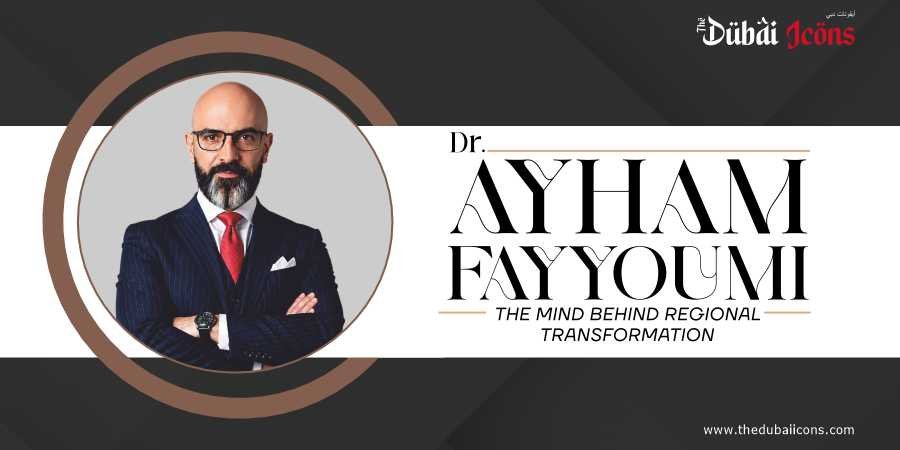
The future of education, skills, and innovation is increasingly being shaped by leaders who can connect vision with execution. Across the Middle East, large-scale transformation is no longer just about launching ambitious national plans or introducing new technologies. It is about building systems that create opportunities, strengthen institutions and prepare societies for what comes next. Dr. Ayham Fayyoumi, Partner at a Leading International Consulting Firm and advisor to senior government leadership across the region, has spent his career working at that intersection where policy, education, and technology come together.
What makes Dr. Ayham Fayyoumi’s journey particularly compelling is that it did not begin in boardrooms or government strategy offices. It began in classrooms, research labs and universities, where he developed a deep understanding of learning, technology and institutional change.
Before becoming an advisor on nationwide transformation initiatives, he built his career as an educator and researcher, publishing several papers in scientific journals and conference proceedings focused on educational technologies, assessment, and programme evaluation. That foundation continues to shape the way he approaches complex challenges today, combining academic rigour with practical execution and a clear belief that meaningful progress is ultimately measured by the lives and institutions it helps improve.
One Journey, Many Roles
Every meaningful career is shaped long before its destination becomes clear. Looking back, Dr. Ayham Fayyoumi sees his path as a series of values inherited, experiences lived and choices made that gradually connected into one story. He often compares that journey to running a marathon. The race itself may last only a few hours, but it is built through months of discipline, resilience, setbacks and thousands of deliberate steps.
His professional life has followed a similar pattern. Rather than viewing academia, research, consulting and government advisory work as separate chapters, he sees them as one continuous journey driven by purpose and a commitment to expanding the human potential.
Education has always been at the heart of that journey. Growing up, it was valued not simply as a pathway to a career but as a way to improve oneself, contribute to society and create opportunities for others. He has spent much of his life in education, first as a student, then as an educator and researcher, and today as an advisor working with governments, schools, universities and research institutions across the Middle East. The roles have evolved, but the direction has remained remarkably consistent.
From Research to Real-World Impact
Research taught Dr. Ayham Fayyoumi to question assumptions, seek evidence and approach complex problems with intellectual discipline. Teaching gave him something equally valuable. It allowed him to understand students’ aspirations, educators’ challenges and the realities of educational institutions from the inside. That experience showed him that education is not only a system to be analysed but also a deeply human experience that cannot be fully understood through reports, data or policy documents alone.
Over time, he realised that producing knowledge was only part of the equation. He wanted to see ideas translated into action and help shape policies, institutions and systems capable of creating opportunities at scale. Consulting became the bridge between research and transformative impact.
Along the way, he also discovered that lasting transformation rarely comes from a single breakthrough. It is built through consistency, continuous learning and the willingness to keep moving forward even when progress appears incremental.
The Middle East’s Ambitious Transformation
During the past decade, Dr. Ayham Fayyoumi has worked closely with governments across the Middle East through one of the region’s most ambitious periods of transformation. What stands out most to him is the scale of that ambition. Countries are no longer asking only how to improve existing education systems. They are asking how to redesign them for new economies, changing skills demands and lifelong learning.
That ambition is visible across national agendas, including Saudi Arabia’s Vision 2030, Qatar National Vision 2030 and the UAE’s ambitions for 2031. While each country has its own priorities, they share a common belief that human capital, education, research, innovation and skills are essential to future competitiveness and prosperity.
This shift is particularly meaningful to him because it reflects a broader understanding of education’s role in national development. Education is not simply a social service. It is an investment in economic competitiveness, innovation, resilience and a society’s long-term ability to adapt. Contributing to that transformation has become one of the most rewarding aspects of his career.
Designing an AI-Enabled Future for Education
The rapid rise of artificial intelligence is accelerating change across education, but Dr. Ayham Fayyoumi believes the conversation often begins with the wrong question. Rather than asking whether AI will replace teachers, he believes the more important question is how AI can help educators, researchers and institutions become more effective.
Throughout his work, he has consistently argued that technology should enhance, not replace, the human experience of learning. AI has the potential to personalise education, automate repetitive tasks, expand access to knowledge and create entirely new learning experiences. Yet education has always been about more than information. Curiosity, empathy, mentorship, judgement and human relationships remain central to meaningful learning.
In his view, the future is not about choosing between people and technology. It is about designing systems in which each strengthens the other. That requires institutions to look beyond simply adopting new tools. They need practical governance, clear ethical principles and genuine engagement with educators, students, researchers and employers. The institutions that succeed will not necessarily be those that deploy the most advanced technologies first, but those that build the trust, capabilities and culture needed to use them responsibly and effectively.
Connecting Vision with Execution
Dr. Ayham Fayyoumi’s academic background continues to shape the way he approaches consulting, but his perspective now extends across the entire education and innovation ecosystem. His work has spanned K-12 education, higher education, digital learning, future skills, research and innovation agendas, institutional transformation and national strategies. Each area brings its own stakeholders, cultures and challenges, yet the core task remains the same: turning ambitious visions into practical change by bringing people, technology and institutional processes together.
Research taught him the value of evidence. Academia taught him the importance of context. Consulting added another lesson that has become central to his work. Even the strongest ideas have little value if they cannot be implemented. A strategy must be rigorous, but it must also be practical, adaptable and capable of delivering measurable results. Real transformation happens when evidence and execution come together with a clear understanding of the people who will experience that change.
When Policy Reaches the Classroom
One experience remains particularly meaningful to Dr. Ayham Fayyoumi: contributing to the development of a national digital learning strategy and then helping support its implementation. What made the project special was its reach. It was not limited to a policy document. It had the potential to influence classrooms across an entire country and shape how students learn, how teachers deliver and how young people prepare for the future.
That experience strengthened a belief he has carried ever since. Transformation is never only about strategy or vision. It is about changing experiences, expanding opportunities and improving lives.
The same sense of purpose that once came from watching students grow in confidence and capability during his academic career now comes from seeing institutions become stronger and impactful. Knowing that students, educators, faculty members, researchers and other stakeholders will ultimately benefit from the changes his team helps create is what makes the work meaningful.
The Marathon Mindset
Leadership, in Dr. Ayham Fayyoumi’s view, is about providing clarity, creating the conditions for others to succeed and having the resilience and humility to keep learning.
Running has become a powerful reminder of that philosophy. A marathon is not completed through one extraordinary effort. It requires consistency, adaptation and the discipline to stay focused on a long-term goal. Transformation follows the same pattern. Sustainable change is built one decision, one partnership and one step at a time.
Long-distance running also gives him something that has become increasingly rare: uninterrupted time to think. Many of his clearest reflections on leadership, education and complex challenges have emerged during long runs, often somewhere between kilometres twenty and thirty.
Rethinking Learning for the AI Era
Looking ahead, Dr. Ayham Fayyoumi believes education is entering one of the most significant periods of transformation in its history. He sees his generation as uniquely positioned between two major technological revolutions. It witnessed the rise of the internet, mobile technologies and digital transformation, and is now experiencing the emergence of artificial intelligence, a shift that may prove even more consequential.
AI is not only changing the tools people use. It is beginning to reshape how they think, learn and work. It may redefine the role of schools and universities, transform professions and challenge society to reconsider what gives human beings distinctive value in a world where knowledge and increasingly sophisticated forms of intelligence are widely accessible.
Education, he believes, will need to evolve accordingly. Systems built heavily around knowledge acquisition will gradually give way to learning that prioritises creativity, critical thinking, adaptability, ethical judgement, collaboration and continuous learning. Technical expertise will remain essential, but it will no longer be enough. Leaders and professionals who succeed in an AI-driven economy will need technological fluency alongside emotional intelligence, systems thinking, resilience and sound judgement.
A Message for the Leaders of Tomorrow
Despite the scale of change ahead, Dr. Ayham Fayyoumi remains optimistic. Every technological revolution has created uncertainty, but it has also expanded human possibility. AI will undoubtedly reshape how people learn, work and live, yet it will not determine the future on its own. That future will depend on the choices societies make, the values they preserve and the leaders they choose to become.
If there is one message he hopes future leaders will remember, it is to stay curious, embrace change and never stop learning. Above all, leadership is about people. Technology matters. Strategy matters. Financial performance matters. But none of them should become the purpose.
The leaders who create the greatest impact are those who care deeply about the people they serve. They invest in their teams, earn the trust of their clients, develop others and build environments where people can thrive. When purpose and people remain at the centre, stronger institutions and stronger societies follow.
Looking back, Dr. Ayham Fayyoumi realises that his journey was never really about becoming an academic, a researcher, a consultant or an advisor to governments. Those have simply been milestones along the route.
The marathon is still unfolding, but the purpose has remained unchanged: a belief that education and skills can transform lives, and that when enough lives are transformed, societies are transformed with them.