
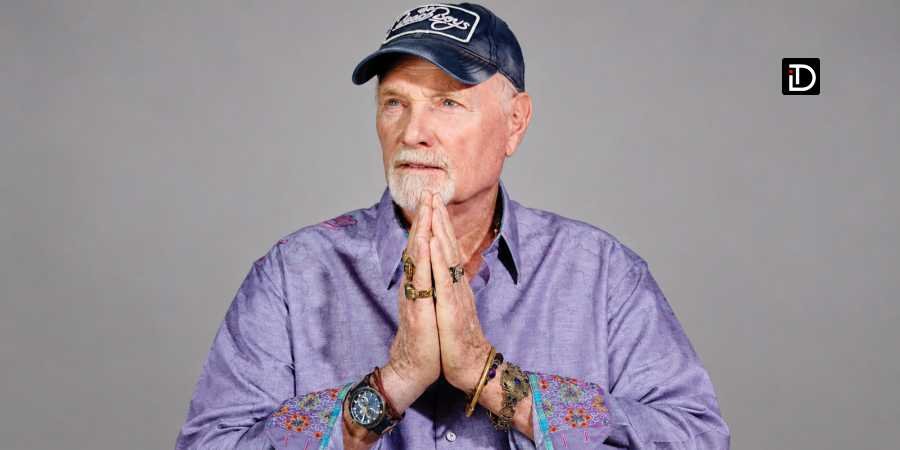
Rock music has always celebrated the idea of growing old without losing the spirit that first brought an artist to the stage. Yet the reality of an eight-decade life in music is more complicated than the familiar image of a veteran performer returning for another encore. At 85, Mike Love, co-founder and longtime frontman of the Beach Boys, is confronting that reality in public, as questions about his health intersect with his determination to continue performing for audiences who have followed the band for generations.
The past few months have brought a difficult chapter in that story. After health-related disruptions forced the Beach Boys to cancel or postpone numerous concerts, Love returned to the stage in Cincinnati on October 10, 2026, for the group’s first public performance in roughly three months. He performed while seated, with assistance from his son Christian Love and longtime collaborator John Stamos. The performance was a reminder of his commitment to music, but it also prompted understandable concern about the physical demands of touring at his age.
A Musical Legacy That Reaches Beyond the Stage
Mike Love helped establish a distinctive sound that became closely associated with California’s youth culture, surf imagery, family harmonies, and the optimism of early 1960s pop. His partnership with cousin Brian Wilson proved central to the Beach Boys’ songwriting identity. Songs such as “I Get Around,” “Help Me, Rhonda,” and “Good Vibrations” became enduring parts of American popular music, while “Kokomo” gave the group another major commercial success in 1988, decades after its early chart-topping years.
Love’s contribution was not limited to his role as a vocalist. His direct, memorable lyrics often provided an accessible counterpoint to Wilson’s sophisticated musical arrangements. That combination helped the group connect with listeners who wanted both musical richness and songs they could immediately sing along with. In 2025, Love was inducted into the Songwriters Hall of Fame, recognition that placed his writing among the lasting contributions of his career.
This history helps explain why Mike Love’s continued presence onstage carries significance beyond the performance itself. He represents a direct connection to the group’s formative years, even as the people and circumstances surrounding the original band have changed. Brian Wilson died in June 2025, and the current touring lineup features musicians who carry the Beach Boys’ catalogue to audiences who may never have seen its original members perform together.
When Health Changes the Shape of a Performance
The recent health concerns have brought a more personal dimension to Love’s career. According to reports published on October 11 and 12, John Stamos said his longtime friend was facing serious health challenges. Earlier difficulties reportedly included bronchitis and COVID-19, alongside the emotional strain of personal losses. The precise nature of Love’s current condition has not been publicly established in detail, so it would be inappropriate to draw medical conclusions from his appearance or the adjustments made to his performances.
The Cincinnati concert nevertheless illustrated how a live performance can change when an artist’s physical capacity changes. Rather than moving around the stage as audiences might remember from earlier years, Love remained seated and contributed vocals. The format was different, but the performance still allowed him to participate in a musical tradition that has shaped much of his life.
For Mike Love, continuing to perform appears to carry an emotional value that cannot be measured simply by stage time or vocal output. Stamos has described the musician’s attachment to the audience and the music, suggesting that the concert environment remains a source of connection and motivation. Such accounts offer a glimpse into why some performers resist stepping away, even when their circumstances change. At the same time, a strong personal desire to continue does not remove the practical importance of medical advice, adequate recovery, and decisions made with family and professional support.
The Demands of Touring at 85
Touring requires considerably more than singing familiar songs. Travel, changing schedules, rehearsals, sound checks, backstage preparation, and the pressure of appearing before large audiences can make a demanding routine for performers of any age. At 85, managing those responsibilities alongside health concerns presents a different challenge from delivering a single concert.
The Beach Boys’ recent schedule has reflected that tension. After an earlier summer break, several planned dates were canceled or postponed, and the band’s return to the road has required adjustments. The group’s official touring information has continued to list performances into late 2026 and 2027, although individual dates remain subject to change. Those listings demonstrate the continuing ambition to perform, but they should not be taken as a guarantee that every concert will proceed as planned.
For Mike Love, a sustainable approach may involve changing the conditions under which he performs rather than treating every show as a test of endurance. Seated performances, a reduced physical workload, carefully planned travel, and flexibility around appearances can allow experienced musicians to remain connected to audiences while acknowledging their limitations. These are general possibilities, not a confirmed account of Love’s medical or touring arrangements. The larger question is whether the schedule can adapt to his needs rather than requiring him to meet the expectations of an earlier stage of his career.
A Career Defined by More Than Longevity
At 85, Mike Love stands at a point where legacy, personal determination, and physical well-being are closely intertwined. His return to the stage shows that the desire to perform remains powerful, even as recent events have made the uncertainty surrounding his future more visible. It also invites a more thoughtful definition of resilience, one that leaves room for adaptation, rest, and the possibility of change.
The most meaningful measure of Mike Love’s next chapter may not be how many concerts he completes or how closely he recreates performances from decades ago. It may be whether he can continue to share the music on terms that respect his health, his wishes, and the people who care about him. The Beach Boys’ songs have survived changing generations and changing lineups. At this stage of his life, the enduring value of Love’s contribution rests not only in his willingness to return to the spotlight, but also in the extraordinary body of music he helped leave behind.