
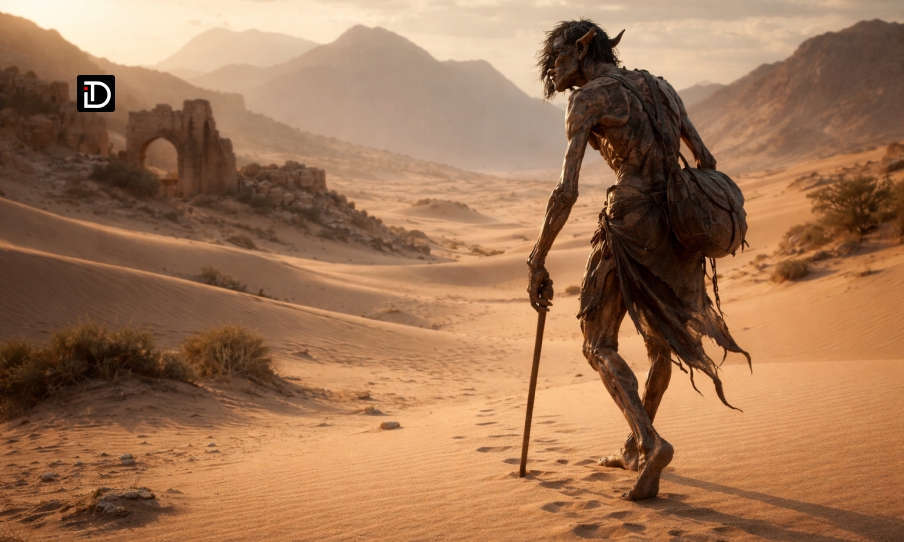
Half buried in desert tales and old beliefs about unseen forces stands a figure too strange to fit any usual ghost story. Not like other spirits born of flame or mist, this one drags itself through myth with twisted flesh. Only one leg moves it forward, dragging behind a body sliced down the middle – single eye watching, lone arm twitching at its side. Stories say it was once whole but lost balance long ago, cursed into lopsided existence. Some call it punishment made visible, others just whisper when shadows stretch wrong. Its form unsettles because it mirrors us – then breaks the mirror. Found flickering at dusk near ruins or dunes where wind cuts silence. Never fully gone, never quite real either. A remnant shaped by fault lines between sin and shape.
Fragments of old tales form the backbone of nasnas myths, much like the broken shape of the beast. Out in Yemen’s far edges, especially around Hadramaut, stories whisper of half-bodied folk who walked Earth before today’s people. Not born fully human, some say they came from a person joined with a jinn – specifically one called a Shiqq. Sitting between two realms – the seen world and the unseen – they blur boundaries others keep strict. Sightings tell of bodies substantial enough to track, even shoot at, but then gone in a bound too wide for any normal stride. Before eyes adjust, the creature is already lost among stones, leaving only doubt behind.
The Half Being Made Visible
One way to see the nasnas is through the unease that comes when something feels half-there. Old writings often say they look like people cut straight down the middle. Picture a figure on two feet, yet missing one entire side – gone without a trace. Even so, lacking balance does not slow them down. On the contrary, legends speak of swift, eerie movement, almost too fast to follow. Some say they move so fast no horse can keep up. Hopping on one leg, they cross rough cliffs and empty sands of southern Arabia. Their shape looks ugly, yet they flow smoothly across the land.
Out of the desert come tales, passed down by wayward scribes like Al-Jahiz and several Persian observers, whispering of beings more than mere beasts – organized, layered lives hidden beneath sandstorms. These figures supposedly spoke, not in words exactly, yet through high-pitched calls or twisted echoes of our voices, designed to pull lone travelers off known paths. What frightens most isn’t noise or shape alone – it’s how closely they imitate us, close enough to fool eyes at dusk, distant enough to stir disgust. Wholeness is something people assume about themselves until stories surface of split shadows moving on two limbs instead of four.
Cultural Impact and Historical Accounts
The legacy of the nasnas extends beyond simple campfire stories into the realm of historical travelogues and early scientific inquiry. During the Islamic Golden Age, scholars often debated the nature of such creatures, wondering if they were actual animals yet to be classified or purely supernatural entities. In “The Meadows of Gold” by Al-Masudi, there are mentions of tribes in the southern reaches of the peninsula who claimed to hunt these beings for food, describing their flesh as sweet but the act of hunting them as perilous. This intersection of the mundane and the mythical is a hallmark of nasnas mythology, where the line between a biological curiosity and a demonic spirit is constantly blurred.
The fear associated with the nasnas jinn was often used as a cautionary tale for those daring to travel alone through the “Empty Quarter” or other unmapped territories. It served as a personification of the dangers of the desert—the heat-induced hallucinations, the crushing loneliness, and the very real physical threats of the wilderness. To encounter one was considered an omen of profound misfortune or a sign that one had wandered too far from the protection of civilization. Even today, the imagery of the half-man survives in regional idioms and local stories, representing the fragmented and unpredictable nature of the unseen world that still lingers in the corners of modern society.
Comparative Folklore and the Modern Echo
When looking at the nasnas through a global lens, one can see parallels in other cultures that deal with themes of physical incompleteness and spiritual malevolence. The Monopod or Sciapod of Greek and Roman myth shares the single-leg trait, but lacks the disturbing “half-human” vertical split that makes the Arabian creature so distinct. The depth of nasnas mythology is rooted in its specific cultural context—the idea that the soul and body are meant to be whole, and that a creature missing half of itself is inherently a corruption of the natural order. This makes the nasnas jinn a particularly potent symbol of chaos and the “other.”
In contemporary times, the interest in such obscure mythological figures has seen a resurgence through fantasy literature and gaming. However, the true essence of the creature is often lost when it is turned into a simple “monster” for an adventure. The real power of the legend is the psychological unease it creates. It forces the observer to question what makes a human whole and what remains when half of our physical reality is stripped away. The story of these beings serves as a reminder that the world of ancient legend is not just filled with dragons and giants, but with unsettling anomalies that reflect our deepest anxieties about our own fragile existence.
Final Reflections on the Shifting Sands
Instead of looking for a definitive end to these stories, it is perhaps more fitting to view the legend as an ongoing dialogue between the past and the present. The desert remains a place of mystery, and as long as there are vast, uninhabited spaces in the world, the shadow of the nasnas will continue to hop across the dunes of our imagination. We may no longer look for their tracks in the sand, but we still feel that ancient shiver when we encounter something that is almost human, yet not quite right. The half-man of the desert endures, not as a proven fact, but as a persistent whisper from a time when the world was much larger and far more terrifying than we can currently conceive.