How Critical Minerals Are Reshaping Global Supply Chains, Technology, Energy Security, and Economic Power
The contemporary economy is founded on materials which do not get much media coverage but without which almost all technological innovations cannot occur. Starting from electric cars and alternative sources of energy through to complex electronics, aircrafts, telecoms and defense technologies, the availability of specialized natural resources becomes ever more crucial for the process of industrialization.
In addition, with nations speeding up technological innovation and economic security, the significance of critical minerals is rising. No longer seen as mere products mined out of the ground, these natural resources are becoming key elements of the development of nations, competitive industrial capacity, and geopolitical strategy.
Powering the Technologies of Tomorrow
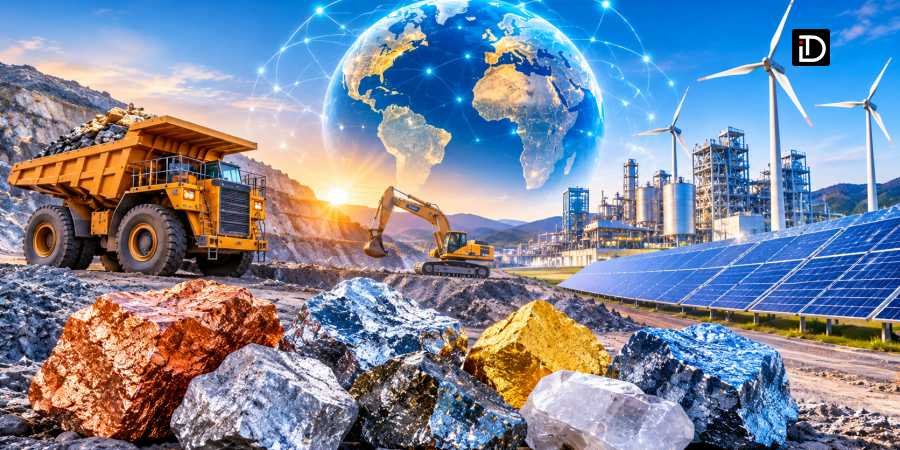
With the growth of electric cars, battery production, digital infrastructure, and clean energy solutions, the market will experience a need for certain minerals that can be used in highly developed production techniques. Lithium, cobalt, graphite, nickel, copper, and rare earth minerals are involved in the process of developing products for storing energy, operating electric motors, energy transfer, and advanced electronics.
As companies create new products, and governments build cleaner infrastructures, these minerals become increasingly important in technology developments. Battery production requires a well-balanced combination of minerals, while wind turbines, solar facilities, electricity networks, and semiconductors depend on certain minerals with special industrial properties.
This increasing demand has encouraged firms to reassess their sourcing practices and explore alternative ways of sourcing, recycling, and procuring these raw materials. Access to these resources may affect the growth of the industry in question and the competitiveness of nations in developing markets.
Supply Chains and the New Geography of Resources
Suppliers of minerals frequently have geographically constrained supply chains, thus posing a problem for businesses that need access to stable sources of mineral supply. There is uneven distribution of mining capacities, production facilities, mineral processing capacity, and manufacturing hubs globally. Such concentration could lead to disruptions in supply from the side of trade disputes, geopolitical instability, logistics problems, environmental constraints, and even shifts in demand.
For policymakers, the issue of critical minerals became a matter of economic resilience. Diversification of supply chain, building up of capabilities and partnerships with resource-rich countries become important considerations for the policy community. The issue becomes also relevant for business when trying to create resilient supply chains.
Increasing importance of economic resilience brings new advantages for countries with both geological endowments and supportive infrastructural, labor, governmental and industrial policies.
Mining Innovation and Responsible Resource Development
More than increasing their activities, meeting the future demand for minerals requires mining companies to take into consideration several factors when extracting these minerals.
With modern techniques of exploration and production, the use of technology, artificial intelligence, and geological data analysis, mining companies have the opportunity to benefit from these new practices, which might allow them to increase their precision and efficiency and make better decisions related to the production process.
Furthermore, developing minerals has an impact on the environment and the society, and thus responsible mining companies should not only think about their needs but also take into account these effects from the very beginning.
The Economic Opportunity for Resource-Rich Nations
With countries that have substantial mineral deposits having a chance of improving their standing within the global economy, merely exporting the mineral deposits may mean missing on additional economic opportunities that can be created from the minerals.
Building processing capacity, refining capacity, advanced manufacturing and other related industries may bring about additional economic gains including jobs for locals and technology transfer. Strategic management of such critical minerals could thus become an important component of economic diversification.
Resource-rich countries that build industrial capacities to extract and process the resources could end up being key players in the technology and energy value chains globally.
Recycling and the Circular Economy
The increasing demand for minerals is also encouraging greater attention to recycling and material recovery. Batteries, electronic equipment, industrial components, and other products contain valuable materials that may be recovered and reused instead of being discarded.
Recycling can help reduce pressure on primary mining, improve resource efficiency, and create new business opportunities in collection, dismantling, processing, and material recovery. However, building effective recycling systems requires investment in technology, infrastructure, product design, and efficient waste-management networks.
As industries develop more circular production models, critical minerals will increasingly be viewed as materials that must remain within productive economic systems for as long as possible. Recovering valuable resources from existing products could become an important complement to traditional mining.
Geopolitics, Trade, and Industrial Competition
The rivalry for mineral supplies on the international level is shaping the process of business partnerships and industrial policy. Mineral supplies are being evaluated not only in the light of economic security and technological development but also of manufacturing capabilities and strategic autonomy.
International cooperation is becoming critical for investment, processing capacity building, technology transfer, and building a stable trade relationship. However, at the same time, countries are striving to limit their dependency on concentrated supply chains and build alternative sources and develop local production capabilities where possible.
The emerging situation makes the environment of doing business more challenging. Not only do companies need to consider the cost-effectiveness and quality of supplies but also their geopolitical implications, regulatory aspects, sustainability criteria, and shipping risks.
Preparing for the Next Phase of Industrial Growth
The future for critical minerals will depend on the willingness of governments, mining companies, manufacturers, technology providers, and investors to adapt to the demands of an evolving industrial landscape. This will occur as a result of changes in innovation, material substitution, advancements in recycling, and the creation of new forms of energy generation systems.
There will certainly be the greatest chances for success in the situations where availability of natural resources is complemented by the existence of a solid infrastructure, proper operation, skillful personnel, advanced processing capacities, and sustainable investment strategy. Businesses which will have a comprehensive vision of how economic, ecological, and technological factors interrelate will be in the best position to adjust to these circumstances.
As the global community moves towards building the industries of the future, there will be no question as to the importance of critical minerals in this process. The impact of this resource stretches far beyond mining to the technologies used by people and the infrastructure built by the nations, as well as the economic relations that underlie world development.