
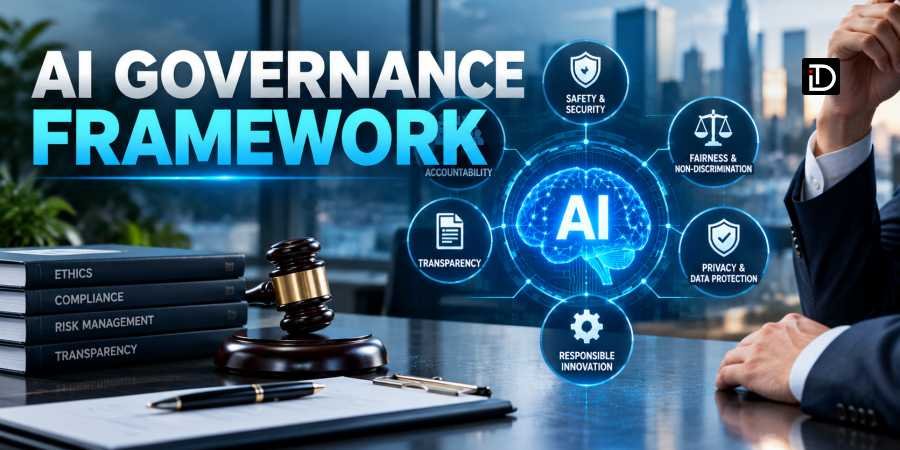
For a new business, artificial intelligence can be a practical shortcut to capabilities that once required much larger teams. A small company might use AI to screen customer enquiries, recommend products, analyse financial information, or generate marketing content. Yet as these tools become part of daily operations, a simple question becomes harder to answer: who is responsible when an AI-supported decision causes harm?
A policy that promises fairness, transparency, and privacy is a useful starting point, but it does not prove those principles are being followed. Businesses need to translate them into controls that can be tested, documented, and reviewed. Effective Responsible AI Implementation is not about creating an elaborate compliance department before a company has found its market. It is about establishing clear responsibilities and proportionate safeguards early, so growth does not leave accountability behind.
Why New Businesses Need an AI Governance Framework
Startups and small businesses often adopt AI through ready-made software, cloud services, and third-party models rather than developing their own systems. This makes experimentation easier, but it can also blur responsibility. A vendor may supply the model, an employee may configure it, and a manager may rely on its output without knowing how it was produced or where its limitations lie.
The governance gap is not confined to young companies. EY’s 2025 Responsible AI Pulse survey found that although 72% of surveyed executives said AI was integrated and scaled across most or all organisational initiatives, only about one-third reported having appropriate protocols covering responsible AI principles.
The finding highlights a broader challenge: adopting AI and governing it effectively are separate achievements.
For new businesses, Responsible AI Implementation should begin with a clear picture of how AI is used. That means identifying approved tools, recording their intended purposes, understanding what information they process, and assessing how their outputs affect customers, employees, or business decisions. A tool that drafts social media captions presents different risks from one that influences loan eligibility or hiring.
This initial inventory need not be complicated. A shared register, a named owner for each system, and a brief assessment of potential harm can provide a workable foundation. The aim is to know what the business is using before an incident, customer complaint, or regulatory question forces the issue.
Turning Ethical Principles into Auditable Controls
Principles become meaningful when people can demonstrate how they are applied. If a business says it protects personal information, it should be able to show which data an AI tool receives, why that data is needed, who can access it, and how long it is retained. If it commits to fairness, it should have a way to examine whether the system produces systematically different outcomes for relevant groups.
This is where Responsible AI Implementation moves from policy language to operational practice. Each principle should be connected to a specific control and evidence that the control works. Human review might be documented through approval records. Data protection might be supported by access restrictions and retention rules. Reliability could be assessed through pre-deployment tests, ongoing performance checks, and records of incidents or corrections.
Auditable controls do not necessarily require expensive software. A small organisation can begin with version-controlled policies, a central record of AI use cases, documented testing results, and a simple approval process for higher-risk applications. As the business grows, those records can move into more specialised governance tools. What matters initially is consistency: decisions should not depend entirely on who happens to be managing the project.
The documentation should also be useful rather than ceremonial. A form completed once and never revisited provides little protection when a model, supplier, data source, or business purpose changes. Controls need a review schedule and a clear trigger for reassessment when the circumstances surrounding an AI system materially change.
Clear Accountability from Founders to Vendors
Governance often breaks down when everyone participates in an AI process but nobody owns its outcome. A developer may be responsible for technical performance, a department head for business use, and a supplier for the underlying model. Yet the customer experiences the result as a decision made by the company, not by a collection of separate contributors.
Responsible AI Implementation requires explicit ownership at each stage. Founders or senior leaders should establish the organisation’s risk appetite and decide which uses require additional scrutiny. Business owners should confirm that an AI system serves a legitimate purpose. Technical teams should test and monitor its behaviour, while legal, privacy, or security specialists provide advice where the risks justify it. In a small company, one person may hold several roles, but the responsibilities themselves should remain clear.
Third-party providers need attention, too. Before adopting an AI service, businesses should examine its data-handling practices, security commitments, known limitations, update policies, and available audit information. Contracts should clarify relevant responsibilities and provide a route for reporting incidents. Outsourcing the technology does not eliminate the need to assess how it affects the business or its customers.
For Responsible AI Implementation to be credible, there must also be a process for challenging decisions. Customers and employees should know where to raise concerns, who will investigate them, and how issues will be resolved. Complaints can reveal weaknesses that routine technical testing misses, making accessible feedback channels a practical risk-management tool rather than an administrative extra.
Use Established Frameworks Without Creating Unnecessary Burdens
New businesses do not need to invent governance from scratch. The US National Institute of Standards and Technology’s AI Risk Management Framework provides a structured approach to identifying and managing AI risks across the technology lifecycle. It can help businesses organise responsibilities, assess likely harms, and review whether safeguards remain effective.
These principles offer useful direction for new businesses, alongside applicable obligations involving data protection, consumer rights, intellectual property, and sector-specific regulation.
The best Responsible AI Implementation approach is proportionate. A company using AI to draft routine internal documents may need clear usage rules and confidentiality safeguards. A business using AI to assess applicants or make decisions with significant financial consequences should expect more rigorous testing, documented human review, and stronger procedures for handling errors. Governance should grow with the potential impact of the technology, not simply with the number of AI tools purchased.
Make Governance Part of Business Growth
A useful framework should help a business move confidently, not bury employees in approvals. Leaders can review a small set of practical indicators, such as whether AI systems have assigned owners, whether required testing has been completed, how often outputs are overridden, and how quickly reported problems are resolved. Regular reviews can then identify gaps before they become costly incidents.
Responsible AI Implementation works best when these checks are built into ordinary business processes, including procurement, product development, employee training, and supplier reviews. This makes governance easier to sustain as the organisation adds people, customers, and new AI capabilities.
For a young business, accountability is not a sign that innovation has gone too far. It is what allows innovation to earn trust. By connecting principles to verifiable controls, assigning responsibility to identifiable people, and reviewing safeguards as the business evolves, founders can create an AI governance framework that is practical from the beginning and strong enough to support future growth.