
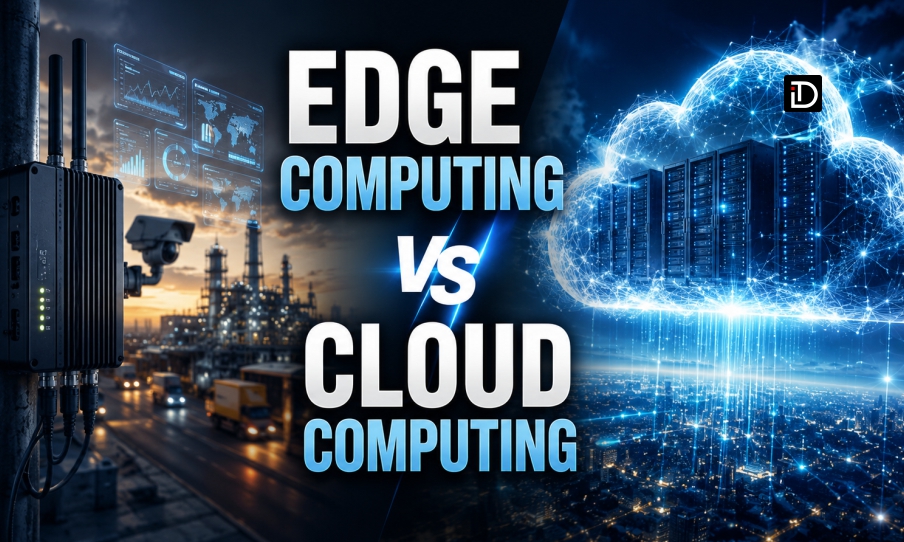
With the increase in the need for processing data and the development of digital technologies, such data is being produced more and more. The use of this data in different areas, be it smart devices, cars, health care, or retail requires a lot of computing power. The need for such technologies as edge computing vs cloud computing emerges because these two resources are usually applied in different ways and serve different purposes.
This divergence makes it difficult for many to understand their differences or even confuse them. However, if you want to build your system using either of these tools, you must understand what distinguishes them so that you can choose the most suitable one.
Main differences between edge and cloud computing
The main difference between edge computing vs cloud computing is where the data is processed. The former implies the processing of information closer to its source, while the latter collects and processes data in a distant cloud. To put it another way, cloud computing uses remote servers to store, manage, and process data through the Internet.
These technologies differ in a variety of ways, including:
- Latency: the cloud requires data to be transmitted over sometimes great distances before it can be processed, while Edge Computing processes information locally
- Scalability: the cloud has virtually unlimited scalability, while Edge is local and thus has limited resources
- Security: data transmission through the cloud may have vulnerabilities and points of damage, while Edge Processing keeps information on local devices and thus is more secure
- Flexibility: Edge Computing offers much more flexibility than the cloud, as it allows processing of data right where it is needed most.
This divergence in the characteristics of cloud and edge computing will allow you to choose which one is better for your business.
For applications requiring real-time decisions, such as industrial automation or connected vehicles, processing information at the edge can dramatically improve performance while reducing dependency on constant internet connectivity.
Performance, Latency, and Scalability Compared
One of the biggest considerations in edge computing vs cloud computing is latency. Cloud platforms are highly efficient for workloads that are not time-sensitive, such as enterprise software, customer relationship management systems, or large-scale analytics. However, because data must travel to distant servers, some delay is unavoidable.
Edge computing minimizes this delay by handling processing locally. Even milliseconds can make a significant difference in applications like robotic manufacturing, video surveillance, healthcare monitoring, or augmented reality. Faster processing enables quicker decision-making, improved user experiences, and enhanced operational efficiency.
Cloud computing still remains unmatched when it comes to large-scale scalability. Organizations can quickly increase computing resources without investing in additional physical infrastructure. Businesses experiencing fluctuating workloads often benefit from cloud elasticity, allowing them to pay only for the resources they consume.
Edge environments, while improving rapidly, typically require distributed hardware deployment and management across multiple locations. Although this introduces additional complexity, the operational benefits often outweigh the costs in latency-sensitive industries.
Security, Reliability, and Cost Considerations
Security is another important factor when evaluating edge computing vs cloud computing. Cloud providers invest heavily in cybersecurity, compliance certifications, encryption, and continuous monitoring. Their infrastructure often includes multiple layers of protection that would be difficult for individual organizations to replicate.
However, transmitting sensitive information across networks may introduce additional exposure if not properly secured. Edge computing helps reduce this risk by processing critical information locally, meaning less data needs to travel over public networks. This approach is especially useful for industries dealing with confidential medical records, financial transactions, or industrial control systems.
Reliability also differs between the two models. Cloud services depend heavily on stable internet connectivity. If a connection is interrupted, certain applications may experience delays or temporary service disruptions. Edge systems can continue operating locally even during network outages, ensuring business continuity for critical operations.
Cost comparisons depend largely on the specific use case. Cloud computing generally lowers upfront infrastructure expenses because organizations rent computing resources rather than purchasing hardware. Edge computing may require greater initial investment in local devices and infrastructure but can reduce long-term bandwidth costs by transmitting only relevant data instead of every data point generated.
Choosing the Right Solution for Your Business
The discussion around edge computing vs cloud computing should not be viewed as choosing one technology over the other. In reality, many organizations successfully combine both approaches to build hybrid architectures that leverage the strengths of each.
For example, a manufacturing facility may use edge devices to monitor equipment in real time and instantly detect mechanical failures. The summarized operational data can then be transferred to the cloud for long-term storage, predictive analytics, and machine learning model training. This combination delivers both immediate responsiveness and enterprise-wide intelligence.
Retail businesses follow a similar pattern by processing customer interactions locally for faster checkout experiences while using cloud platforms to analyze purchasing trends across multiple stores. Healthcare organizations also benefit from edge processing for patient monitoring while maintaining centralized medical records in secure cloud environments.
Businesses should evaluate application latency requirements, regulatory obligations, internet reliability, data volume, maintenance capabilities, and future growth plans before selecting an architecture. Workloads requiring immediate responses generally benefit from edge deployments, while centralized applications with large storage requirements continue to perform exceptionally well in the cloud.
As technologies such as artificial intelligence, Internet of Things (IoT), and 5G networks continue to mature, both computing models will become increasingly interconnected. Rather than competing technologies, they complement one another by addressing different operational challenges.
Organizations that understand the strengths of each approach can build flexible infrastructures capable of delivering higher performance, stronger resilience, and better customer experiences. Instead of asking which technology is superior, businesses should determine how both can work together to meet their unique objectives, ensuring they remain competitive in an increasingly data-driven digital landscape.