
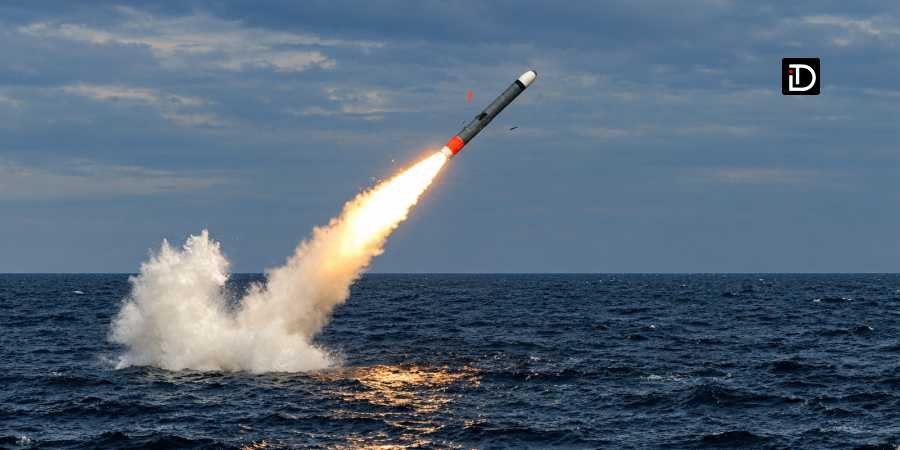
Modern naval warfare is increasingly shaped by long-range weapons, advanced surveillance systems and the ability to strike targets without bringing ships or aircraft close to hostile territory. Within this changing environment, the Tomahawk Cruise Missile continues to occupy an important place in the United States Navy’s capabilities. First used in combat during the 1991 Gulf War, it has evolved through successive upgrades while retaining its central purpose: allowing naval forces to strike land targets from a considerable distance.
Its continued relevance reflects more than the longevity of a single weapon. The Tomahawk Cruise Missile connects naval mobility with precision strike capability, giving commanders options that would otherwise require aircraft, forward bases or other assets operating closer to a conflict zone. As the United States invests in newer versions and expands production, the missile remains a significant part of the wider debate about naval readiness, deterrence and the cost of sustaining modern military power.
How the Tomahawk Cruise Missile Changed Naval Strategy
The Tomahawk Cruise Missile helped expand the role of surface ships and submarines beyond traditional maritime missions. Rather than focusing exclusively on controlling sea lanes or engaging enemy vessels, naval platforms equipped with these missiles can also contribute to attacks against targets on land.
According to the U.S. Navy, the weapon is designed for long-range, all-weather land attack missions and can be launched from compatible surface ships and submarines. Its first operational use came during Operation Desert Storm in 1991, establishing a role that has continued across subsequent conflicts. The Naval Air Systems Command reports that more than 2,300 Tomahawks have been used in combat since January 1991.
This capability changes how naval forces can contribute to a broader military campaign. A ship positioned at sea can provide strike capacity without depending entirely on nearby airfields. Submarines offer another launch platform, adding flexibility to how forces are deployed. The missile therefore gives naval commanders an additional way to apply pressure while preserving options for other missions.
Why Precision and Range Still Matter
One reason the Tomahawk Cruise Missile remains relevant is its combination of long range and precision navigation. The U.S. Navy lists the Block IV and Block V variants with a published range of approximately 900 nautical miles, or about 1,600 kilometres. The weapon uses multiple navigation technologies, including inertial navigation, terrain contour matching, digital scene matching and GPS.
That range gives commanders greater freedom in deciding where ships and submarines operate relative to a target area. It can reduce the need to bring launch platforms close to defended coastlines, although it does not make those platforms invulnerable or guarantee that a missile will reach its intended destination.
Precision also matters because modern military campaigns involve competing demands on limited resources. A long-range weapon can offer another means of striking a selected target without requiring a crewed aircraft to fly the entire mission through potentially dangerous airspace. The operational value depends on intelligence quality, target selection, mission planning and the broader conditions in which the weapon is used.
The Tomahawk Cruise Missile Continues to Evolve
The Tomahawk Cruise Missile has remained in service partly because the system has been upgraded rather than left unchanged. The Block IV generation introduced the ability to receive updated mission information during flight, including through two-way satellite communications. This gave commanders greater flexibility than a weapon whose mission could not be adjusted after launch.
The Block V generation builds on that approach. The Navy describes improvements to navigation and communications, alongside plans for additional variants. Block Va, known as the Maritime Strike Tomahawk, is intended to add an anti-ship capability, while Block Vb is associated with a replacement warhead system designed for a wider range of target effects.
These changes reflect a broader military procurement principle: upgrading an established system can preserve useful capabilities while introducing new ones. It also allows existing launch platforms and support structures to remain relevant as operational requirements change.
Recent Conflicts Have Reinforced Its Strategic Role
The Tomahawk Cruise Missile has continued to appear in reporting on contemporary military operations. Reuters reported that U.S. forces used Tomahawk missiles alongside combat aircraft and other weapons during strikes on Iran in March 2026. The reported deployment illustrated how long-range missiles remain part of a larger mix of military capabilities rather than serving as a standalone solution.
Such examples demonstrate the weapon’s continued operational relevance, but they also highlight an important distinction: the presence of a missile in a strike does not, by itself, establish whether a campaign achieved its wider political or military objectives. Outcomes depend on the mission, the target, intelligence assessments, defensive responses and the consequences that follow.
Long-range precision weapons can provide options for military planners, but their use raises questions about escalation, civilian protection, legal obligations and the possibility of retaliation. Their strategic value cannot be assessed solely by range or technical performance.
Production Capacity Is Becoming Part of Military Readiness
Another reason the Tomahawk Cruise Missile matters is the challenge of maintaining sufficient stockpiles. Advanced weapons require specialized components, skilled labour, testing and long-term industrial investment. If combat operations consume missiles faster than manufacturers can replace them, the resulting shortage can affect readiness well beyond the immediate conflict.
In August 2026, the U.S. Navy announced a $22.9 billion contract with RTX’s Raytheon business intended to accelerate Tomahawk production. The announcement placed the weapon within a wider effort to expand the American munitions industrial base and improve delivery capacity.
The size of the contract signals the importance attached to long-range strike capacity, although a contract value should not be mistaken for the price of a single missile or proof that production bottlenecks have already been resolved. Expanding manufacturing output takes time, particularly when supply chains and testing requirements are demanding.
Why the Tomahawk Cruise Missile Still Matters
The enduring significance of the Tomahawk Cruise Missile lies in the combination of range, precision, platform flexibility and an established support system. Decades of operational use have given the weapon a place in naval planning, while successive upgrades and renewed production efforts seek to keep it relevant as threats evolve.
Its future role will depend on whether modernization, manufacturing capacity and integration with other military systems can keep pace with changing conditions. The missile cannot replace every other capability, and its use does not guarantee a particular strategic outcome. It remains, however, an important instrument for extending naval strike options beyond the immediate maritime battlespace.
In modern naval warfare, the ability to project power from a distance remains consequential. The Tomahawk Cruise Missile continues to serve that purpose, not because naval warfare has stood still, but because the weapon has been adapted to changing operational demands while remaining part of a much larger military system.